Skip to content
ZANAILSAcademy · resources

In-person training · Ottawa–Gatineau

In-person manicure courses
that review your own technique

One-on-one and group training for nail artists who want to understand not just how to repeat a technique, but why the result turns out the way it does.

We look at your own work, your mistakes and the logic of your hand movements, and we pitch the explanation to your level — no pressure, no talking down, and no one-size-fits-all script.

The program is built around your goal: strengthen your foundation, fix recurring mistakes, get a handle on architecture, improve wear, feel more confident with difficult clients, or reach a higher professional level.

The focus is on safety, clean technique, understanding your materials, and a consistent result you can reproduce — not just during training, but in real work with clients.

25 years in the profession~20 years teachingInternational judgingWins at professional championshipsOttawa–Gatineau
Zulfiia Anikanova — Method creator and instructor

Method creator and instructor

Zulfiia Anikanova

Manicure expert, creator of training programs, instructor with 25 years of experience, international judge and winner of professional championships.

I’ve been in this profession for 25 years, and for about 20 of them I’ve been teaching. Along the way, manicure stopped being just a pretty service to me.

For me it’s a system: technique, architecture, safety, understanding the natural nail, working with the material, and knowing how to choose the right solution for each client.

My career has taken me through different countries, schools and markets. And that’s exactly what gave me the key insight: a strong artist is made not by one brand or one “magic jar,” but by the logic behind the work.

I teach you not to depend on the material, but to understand what you’re doing, why it works, and how to adapt your technique to different hands, nails, clients and situations.

DonetskKyivStockholmOttawa–Gatineau

When in-person training helps

When your work needs to be seen in person

Sometimes the problem isn’t that you’ve studied too little. Sometimes an instructor needs to see your hand, your movement, your pressure, your form, your material — and the exact moment where the result starts to break down.

That’s exactly what’s hard to catch on video, but quick to see in person.

Starting out

You want to start right from the very beginning

You need a calm foundation, a clear sequence, and the confidence that you’re not skipping important steps.

In training we set your technique up right from the start, so you don’t have to relearn it later and undo mistakes your hands have already memorized.

Inconsistent results

You’re working, but the result isn’t always predictable

Sometimes it’s clean, sometimes not quite. Sometimes the coating wears well, sometimes it lifts. Sometimes the shape comes out right, sometimes it drifts again.

In person, we don’t go over general theory — we look at your specific movements, your sequence, and the exact spot where the mistake appears.

Leveling up

You’re already working, but you want to go further

When you already have clients, experience and your own habits, an outside perspective on your work matters even more.

We go through quality, speed, cleanliness, architecture, service and professional decisions — without dismissing your experience, but honestly and to the point.

Recurring mistakes

You’re tired of fixing the same thing over and over

If you keep getting lifting, uneven shape, overloaded material, loss of speed, cuticle problems or anxiety about difficult clients — it isn’t always “a bad hand.”

More often than not, it’s one wrong step in the technique that needs to be spotted and rebuilt.

After training

What will change in your work after training

Not just “learning a technique,” but understanding how to apply it on different hands, with different nails, materials and real client situations.

See the architecture of the nail and build the shape not “by eye,” but for the specific nail plate

Choose the material to suit the nail, the load and the client’s needs, instead of using one approach for everyone

Correct nails that grow downward, break, hook, or won’t hold length

Work the cuticle cleanly and gently — without over-filing, cuts, hangnails or inflammation afterward

Photograph your work so the shape, the cleanliness and your skill level come through in your portfolio

Work faster without losing cleanliness, shape or control at any stage

What we can cover

Topics you can combine to fit your goal

We don’t give every artist the same script. In training you can focus on a single topic or build a program from several areas — depending on your level, your experience and whatever is getting in the way of your results right now.

01

Foundations, diagnosis and architecture

Covering the fundamentals: how to read the nail and skin, choose the right material, build the shape, and avoid overloading the natural plate.

A good fit if you want more than to “follow the steps” — you want to understand why it’s done this way.

02

E-file manicure and a clean cuticle

Working with the bit, the cuticle and the side walls: how to get a clean result without over-filing, cuts, hangnails or skin damage.

A good fit if you want the manicure to look neat not just right after the service, but several days later too.

03

Structured manicure and reinforcement

Covering the apex, balance, thickness, load and choosing the material for the specific nail.

A good fit if your coating looks flat or overloaded, won’t hold its shape, or doesn’t wear consistently.

04

Difficult nails and repair

Covering thin, damaged or weakened nails, lifting, injuries, and cases left behind by poor work.

A good fit if you want to know when you can work, when you need to change your protocol, and when it’s important to stop and refer the client to a specialist.

05

Speed without losing cleanliness

Covering your sequence, your movements, material control and working pace.

A good fit if a service takes you a long time, you get tired, lose focus, or are afraid to speed up because quality drops.

06

Safety, service and the client consultation

Covering sterilization, hygiene, consultation, the limits of your responsibility, and communication with the client.

A good fit if you want to work with more confidence: explain your decisions clearly, ask the right questions, spot contraindications and build trust with the client.

Difficult cases

Before and after: real cases that teach you to see the cause

These aren’t just “before and after” photos. They’re situations where it matters to understand the cause: why the nail breaks, why the coating won’t hold, why the shape drops downward, why the skin gets damaged, or why the result looks inconsistent.

In training we work through cases like these step by step: diagnosis, choice of material, architecture, technique, and the right solution for the specific client.

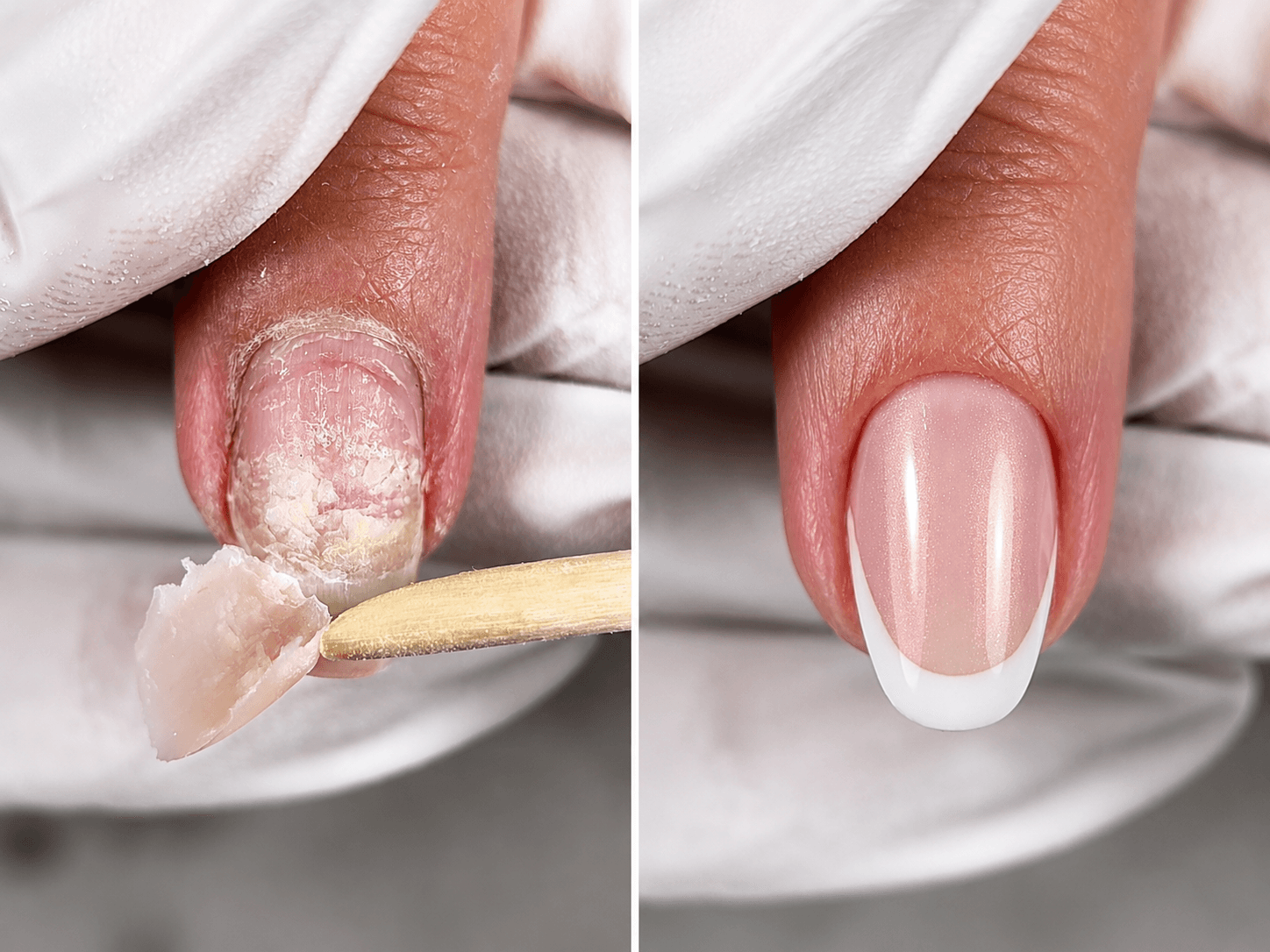
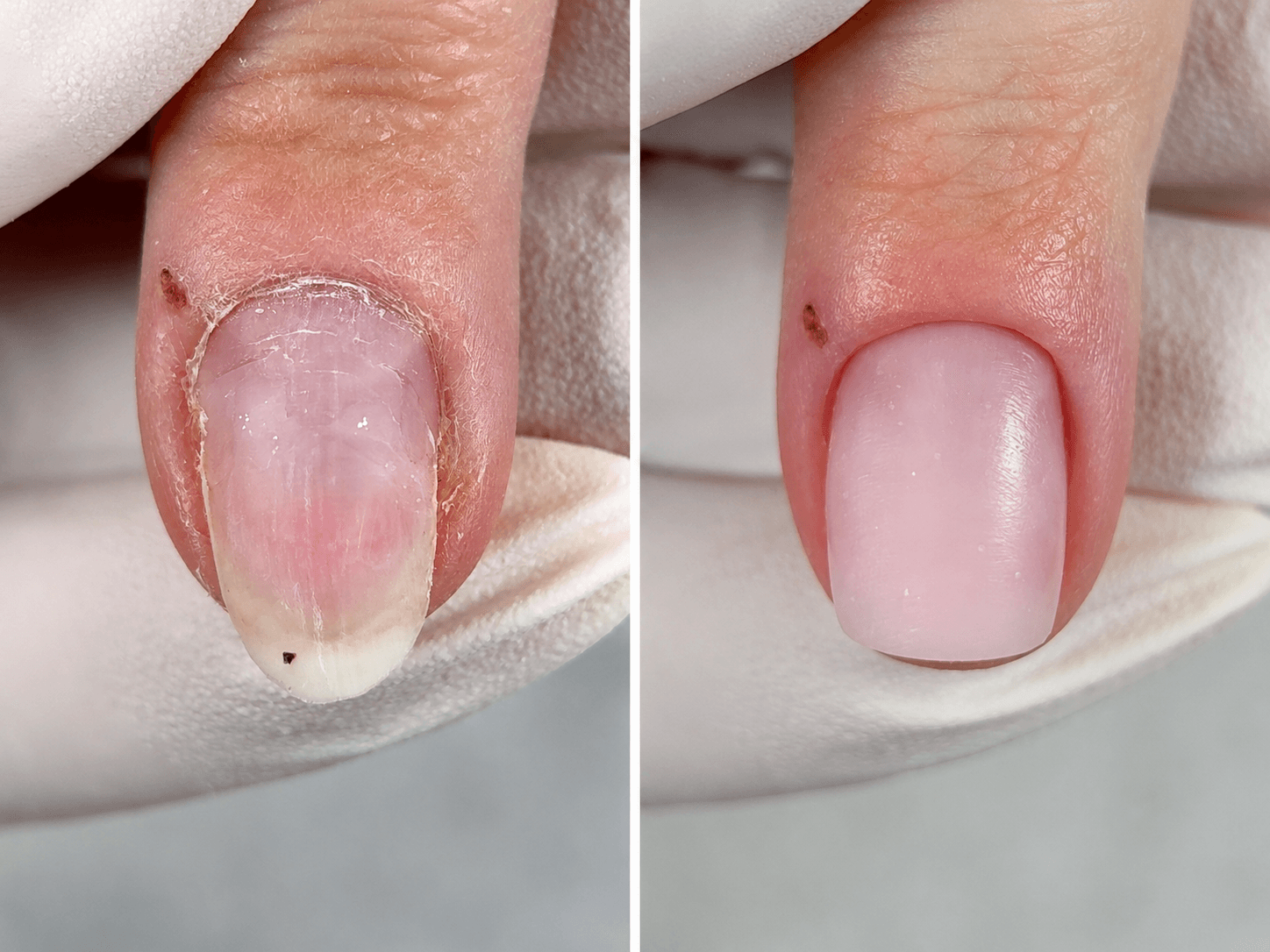
Before / After: Nails that keep breaking and won’t grow outBeforeAfter

Nails that keep breaking and won’t grow out

When nails keep breaking, the problem often isn’t “weak nails” — it’s the load, the shape and a flawed architecture.

In a case like this, the key is to remove what no longer holds up, not to keep length at any cost, and to rebuild the shape — so the nail can grow safely and without constant breakage.

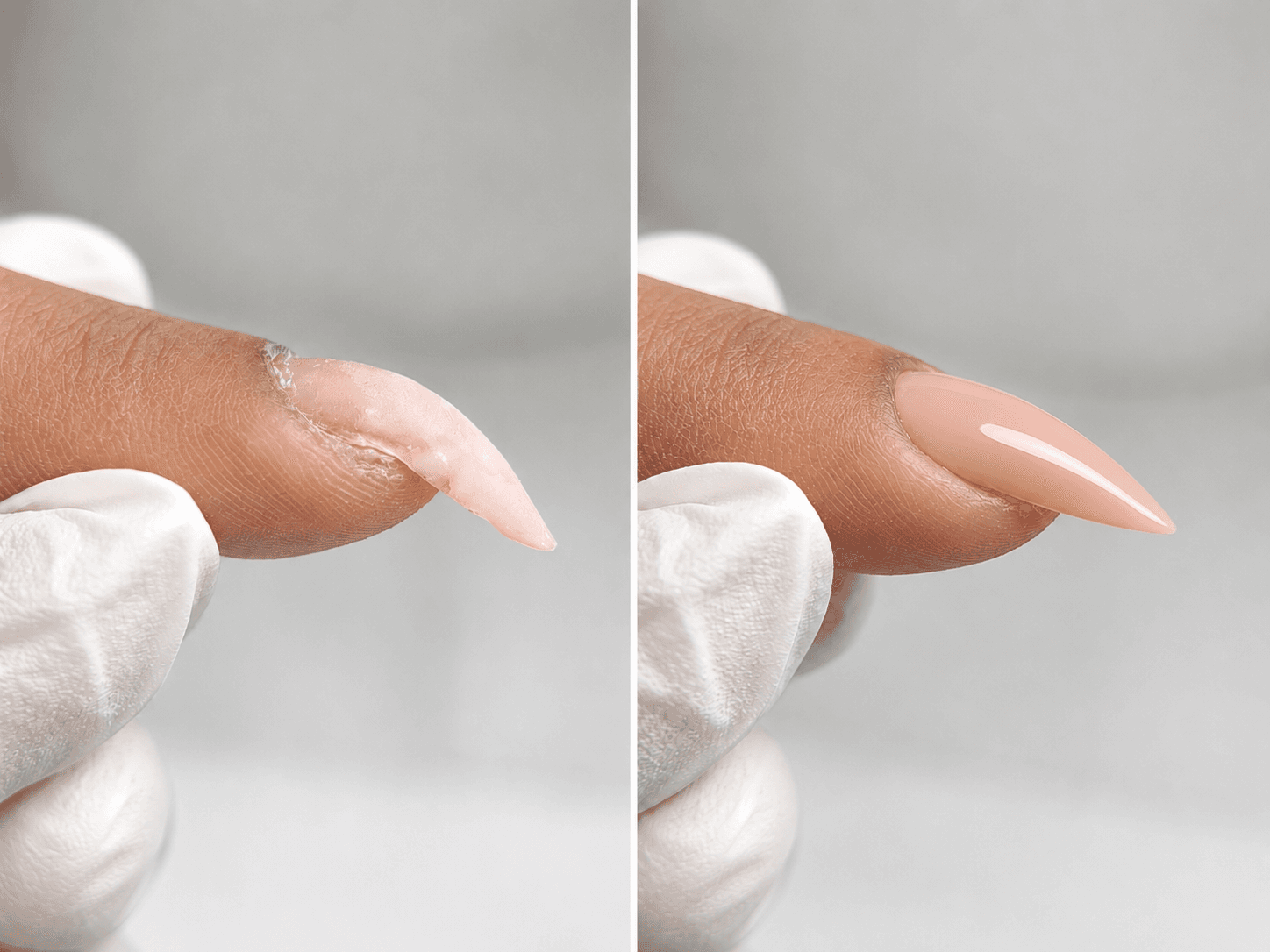
Before / After: Nails that grow downward or “hook”BeforeAfter

Nails that grow downward or “hook”

When a nail grows downward, a simple coating doesn’t solve it. Such a nail often cracks, breaks, or visually pulls the whole shape down.

The point here isn’t to “mask” the problem, but to change the direction, place the material correctly and balance the load, so the shape looks lighter and wears more reliably.

Before / After: Lifting that keeps coming backBeforeAfter

Lifting that keeps coming back

If lifting keeps recurring, the problem usually isn’t only the material. It pays to look deeper: prep of the plate, the nail type, skin moisture, the load, the thickness of the coating, the stress zone and the client’s habits.

In training we work out how to find the real cause, instead of just switching from one base to another.

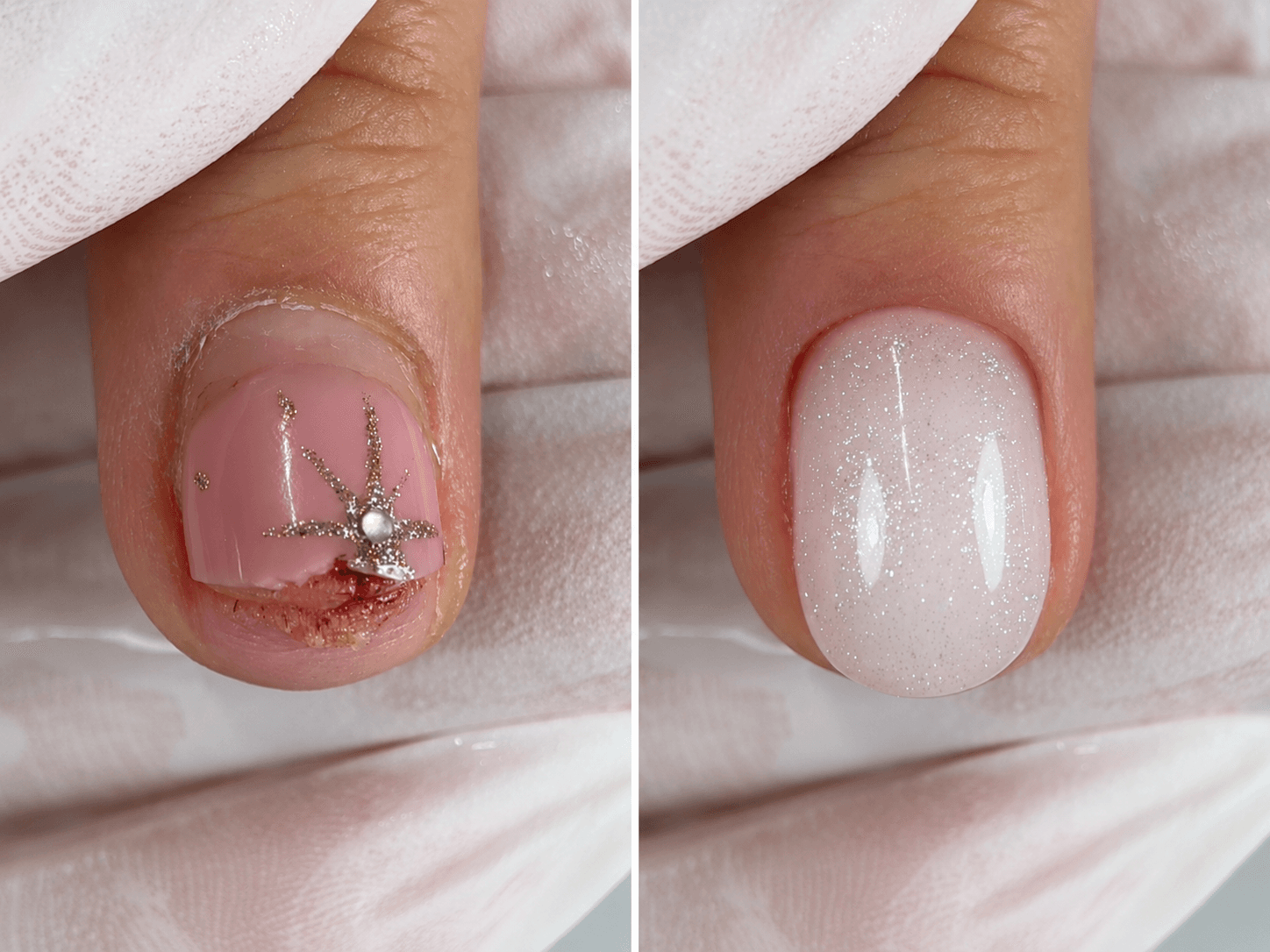
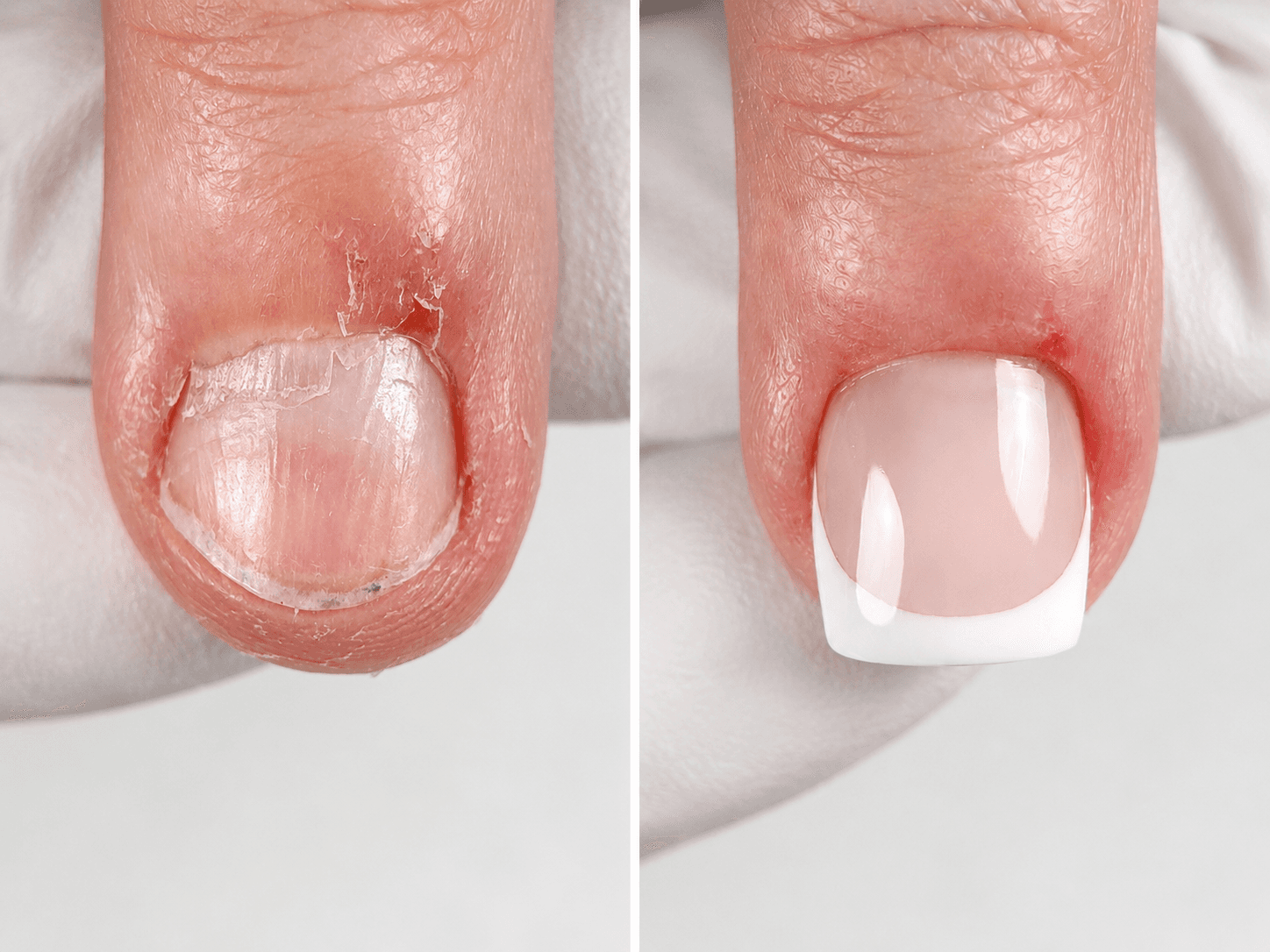
Before / After: An injured nail: when you can’t just coat over itBeforeAfter

An injured nail: when you can’t just coat over it

The most dangerous mistake is to see an injury and simply cover it with material.

If there’s an open wound, inflammation or tenderness, material must not be applied. In such cases it’s important to assess the nail’s condition, treat the area as gently as possible, avoid causing further injury, and choose a safe option: sometimes protection, sometimes a pause, sometimes a referral to a specialist.

Before / After: Deformation and overload in the stress zoneBeforeAfter

Deformation and overload in the stress zone

When the stress zone is overloaded, the nail can crack, deform, hurt, or look heavy even after coating.

In cases like this, the point isn’t to “add more material,” but to understand the cause: where the load is, why the shape can’t take it, how to distribute the material, and what to tell the client about home care.

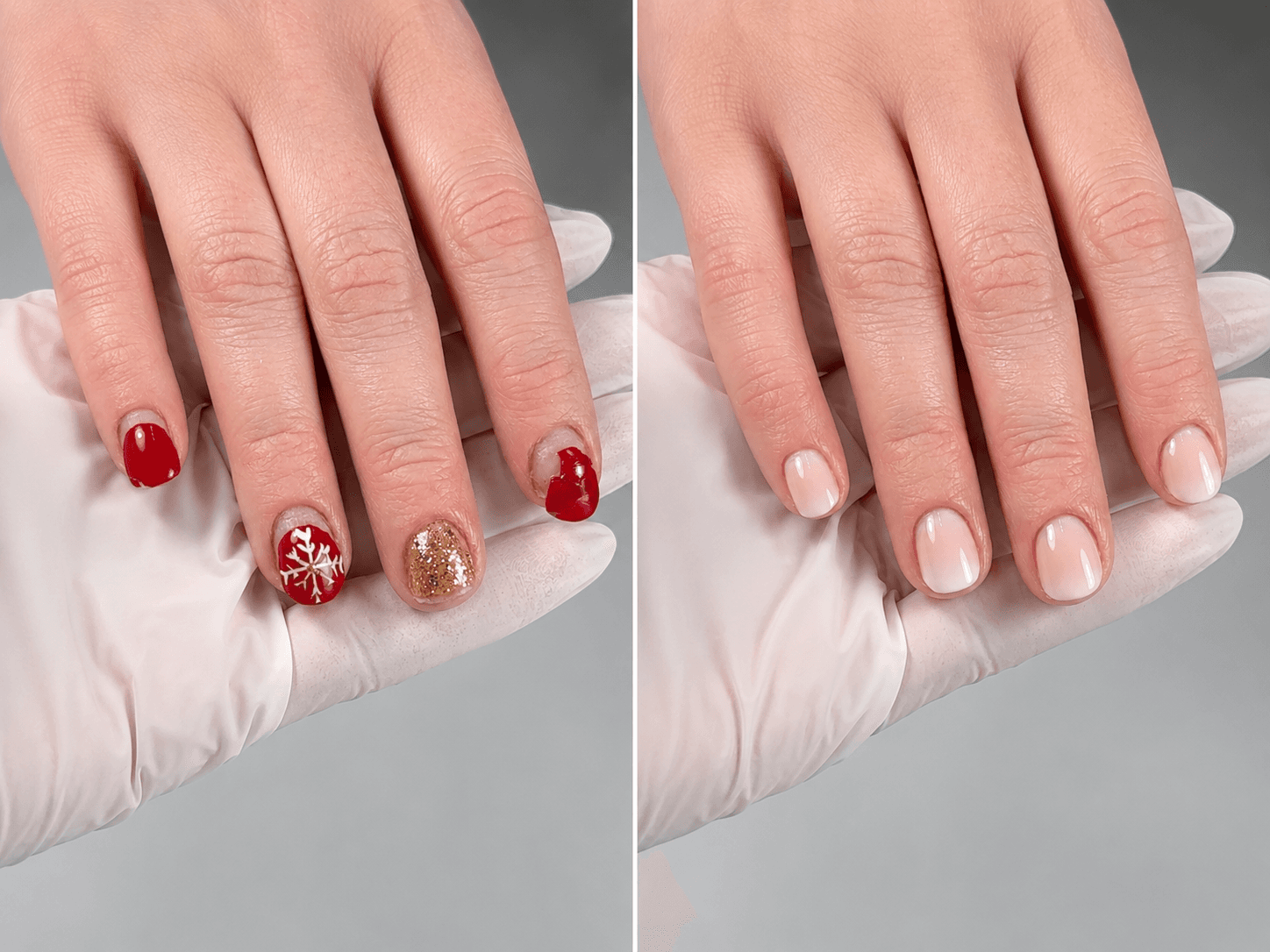
Before / After: A thin cuticle that’s easy to injureBeforeAfter

A thin cuticle that’s easy to injure

You can’t work thin, sensitive skin by force. One wrong move and you get cuts, burning, inflammation, or hangnails a few days later.

In such cases it’s important to open the area gently, remove only what truly needs to go, keep the skin intact, and apply the coating close — but safely.

Training format

One-on-one or in a small group — we pick the format that fits your goal

First we look at your level, your experience and your goal. Then we suggest the format that will give you the most value: more personal feedback, or more hands-on practice in a working atmosphere.

One-on-one training

One-on-one with your instructor

from 700 CAD per day

A format for the artist who needs maximum focus on their own technique, movements, mistakes and speed.

We work at your pace and look at your specific hand, your sequence and the exact things getting in the way of a consistent result.

  • a program for your level and goal
  • a review of your movements and recurring mistakes
  • a pace with no pressure and no rush
  • more time for questions and personal correction

Small group

Training in a small group

from 500 CAD per spot per day

A format for artists who want not only to practice, but also to see different hands, different mistakes and different solutions.

In a small group you work under the instructor’s guidance, watch other artists’ work be reviewed, and learn to see technique more broadly — not just through your own case.

  • up to 4–6 artists per group
  • practice under the instructor’s eye
  • a review of different techniques, hands and mistakes
  • in-person training in a more accessible format

Course pricing

Pricing depends on the format and your goal

We don’t sell everyone the same package. First we clarify your level, your goal and what you’re looking for, then we suggest a format, a duration and an exact price.

Applying doesn’t commit you to paying — it’s there so we can understand your goal and find training that genuinely makes sense for you.

One-on-one

from 700 CAD

per day

For those who need a personal review of their technique, movements, mistakes and working pace.

The program is built around your level, your goal and the specific things you want from the training.

Small group

from 500 CAD

per spot per day

For those who want hands-on practice and a review of different hands and mistakes, but in a more accessible format.

You work under the instructor’s eye and learn not only from your own case, but from other artists’ cases too.

Comprehensive program

Full training

40–80 hours

For artists who need more than a single day of review — a complete system: from the foundations to confident, independent work, or a thorough upgrade of their skills.

The price is set after a consultation and depends on your goal, the number of days, the format and the depth of the program.

How signing up works

From application to training — calm and pressure-free

Applying doesn’t commit you to paying. It’s there so we can understand your level and your goal, and suggest a format that genuinely suits you.

01

You send an application

You briefly tell us about your experience, your goal and the format you’re interested in: one-on-one, small group or comprehensive.

02

We clarify what you need

We look at what you need right now: a calm start, a review of specific mistakes, a step up in level, or a program for a more ambitious goal.

03

We match a format and price

Once we’ve clarified your request, we suggest a suitable format, duration, price and the nearest available dates.

04

You come to your training

In the session we work on your technique: practice, adjusting your movements, reviewing mistakes, and a clear plan for what to work on next.

Online academy or in-person training — which is right for you?

Online academy

  • structured learning at your own pace
  • access to lessons and materials 24/7
  • you can learn from any country
  • ideal if you want to calmly put your knowledge in order

In-person training

  • a personal review of your technique
  • practice under the instructor’s eye
  • correction of movements, shape and mistakes
  • ideal if you need to see exactly where the result breaks down

Good to know

Before you send your application

A quick word on documents, pricing, format and terms — so you know how the training works before you even get in touch.

What document will you receive?

After the training you’ll receive a ZANAILS Academy certificate of completion for an original professional-development program.

Please note: this is not a government DEP Esthétique diploma. That diploma is issued only by accredited vocational-training centres in Quebec.

The certificate confirms that you completed training in the original ZANAILS Academy method.

How much does the training cost?

One-on-one training — from 700 CAD per day. Small group — from 500 CAD per spot per day.

A comprehensive 40–80-hour program is priced individually after a consultation: the cost depends on your goal, level, format and the length of the training.

Applying doesn’t commit you to paying.

Can you apply if you don’t know the format yet?

Yes. In the form you can choose the “Not sure yet” option.

After you apply, we’ll calmly go over your level, your goal and your request, then suggest the format that fits best: one-on-one, a small group, or a comprehensive program.

Is the training suitable for beginners?

Yes. If you want to build the right foundation from the very start, in-person training can be a great way to begin.

In the session you don’t just watch a demonstration — you get explanations, practice, movement corrections and a clear working sequence right away.

Where does the training take place?

The training takes place in Ottawa–Gatineau.

We confirm the exact address, dates, duration and format after you apply — depending on the program you choose and the available schedule.

If it’s easier to hold the training in your own city, we discuss a travelling format too — separately, around your dates and your goal. Just mention it in your application and we’ll figure out together how to make it work.

Is this connected to the online academy?

Yes — it’s one method, but two different formats.

The online academy is right for structured, self-paced learning on your own. In-person training is for a personal review of your technique, practice and movement correction.

You can choose one format or combine both — for example, cover the foundations online first, then refine your technique in person.

Application

Apply for an in-person course

Answer a few questions — it helps us understand your level and your goal, and suggest a suitable format without a lot of back-and-forth.

After you apply

We’ll clarify your request, suggest a possible format and point you to the nearest options. Applying doesn’t commit you to paying.

Which format are you interested in? *
Your current level *
What are you interested in?
Message us on Instagram

Your answers are used only to match you with a training format. If it’s easier, you can message us directly on Instagram.

Legal information

The program is an original professional-development method by Zulfiia Anikanova. A ZANAILS Academy certificate is issued on completion. The program is not a government DEP Esthétique diploma — the DEP is issued only by accredited vocational-training centres in Quebec. To obtain the government DEP qualification, please contact those centres directly.